 Holiday Lighting Guide · Permanent Lighting
Permanent vs. Traditional Christmas Lights
How app-controlled eave lighting compares to a classic seasonal install, and how to choose for your Houston home.
Get a Free Quote →- The W in RGBW is a dedicated white diode, which gives permanent track a clean warm white instead of the bluish white of mixed red, green and blue.
- Big-bulb C9s suit Georgian, Tudor and classic brick; the continuous permanent line often fits modern, stucco and Mediterranean homes.
- Permanent track covers only the roofline, so wrapped live oaks, garland and wreaths still go up as a smaller seasonal install.
- Permanent costs more up front but removes the yearly roofline install; it pays off best for owners staying several years.
- Permanent track is a fixture on the house, so check your deed restrictions and any architectural review before you sign.
Traditional Christmas lights are commercial-grade C9 or C7 bulbs clipped to your roofline each November and removed in January, while permanent lights are a trim-matched track of app-controlled RGBW LEDs mounted under the eaves that stays up all year. Traditional wins on classic big-bulb charm and full-yard design; permanent wins on year-round flexibility and never booking a roofline install again.
The right choice depends on your architecture, your deed restrictions, how many holidays you celebrate and how long you plan to stay. Here's how the two compare on a Houston home.
What a Traditional Seasonal Install Looks Like
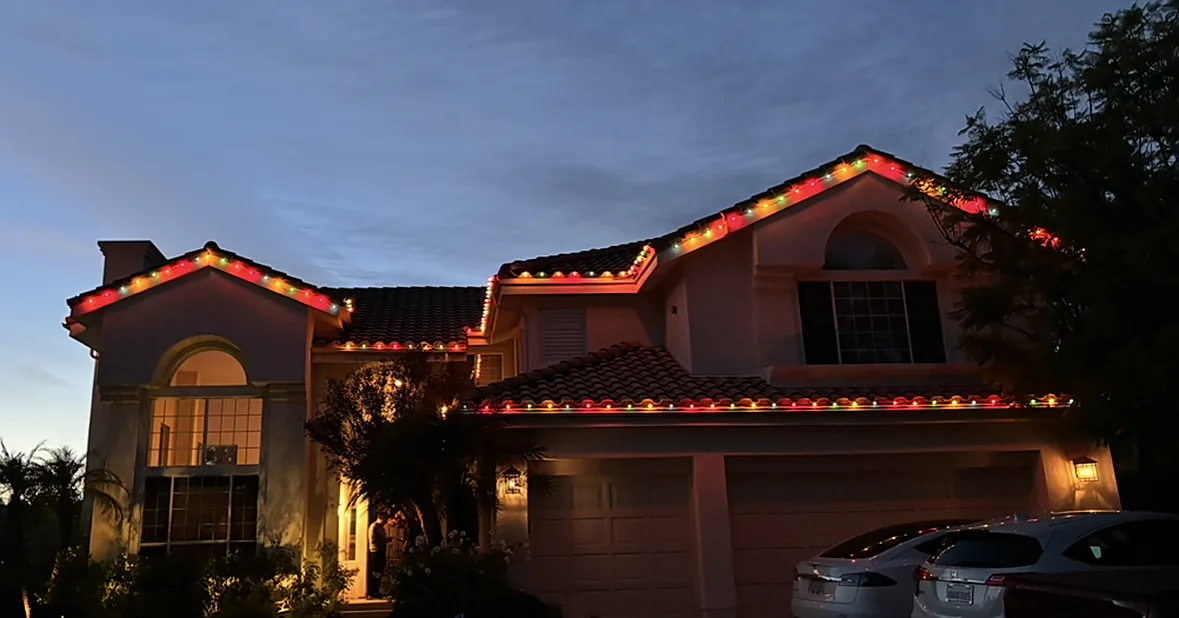
A traditional install is the classic Christmas look. Commercial-grade LED C9 or C7 bulbs sit in sockets on bulk SPT-2 wire, custom-cut to each run of roofline and attached to the gutter lip or shingle edge with all-in-one clips, so the bulbs stand upright in a straight line, commonly every 12 inches. Warm white is the classic choice, while multicolor suits families and playful front yards.
A seasonal install also goes beyond the roof. It's where wrapped live oaks, lit magnolias, garland on columns, wreaths on gates and holiday pathway lights come in. Everything goes up in November, gets in-season service calls in December and comes down in January to be stored for next year. Our Christmas light installation page covers the full scope.
What Permanent Lighting Looks Like
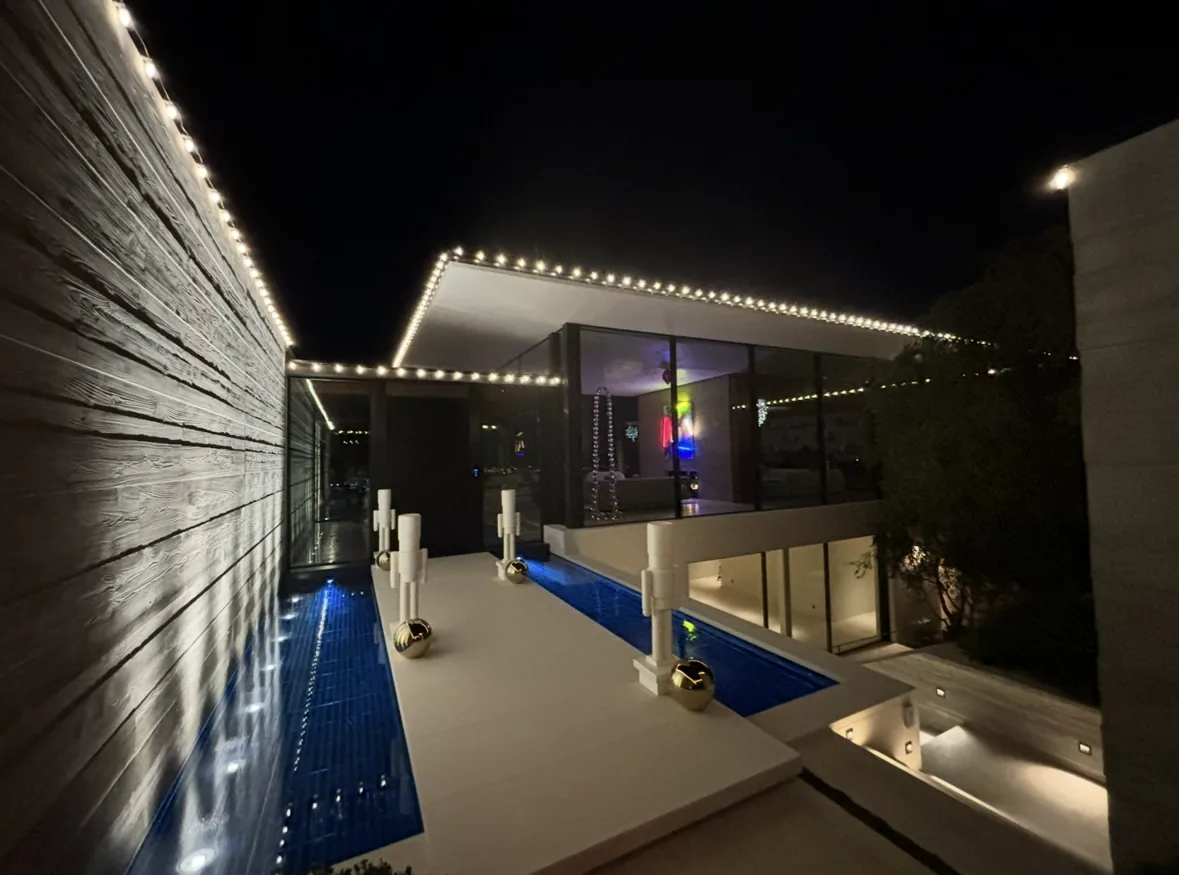
Permanent lighting is a slim aluminum channel mounted to the fascia or just under the soffit edge, color-matched to your trim. Inside are individually addressable RGBW LED nodes set at a fixed spacing. The W matters: a dedicated white diode produces a clean warm white or true white instead of the bluish white you get from mixing red, green and blue.
The LEDs run on low voltage from a power supply that plugs into an existing outlet, usually in the attic or garage, and a Wi-Fi controller connects the system to an app. By day the track disappears into the trim. At night it can be soft warm white, a full Christmas scene, slow color fades or anything in between, on schedules you set once. See our permanent Christmas lights page for details.
Permanent vs. Traditional Christmas Lights, Side by Side
The look
Seasonal C9 bulbs have a dimensional, nostalgic glow. You see each bulb, and that's part of the charm. Permanent lighting reads as a cleaner line of points tucked under the roof edge, with no visible clips or wire. On a red-brick Georgian or a half-timbered Tudor, big bulbs often suit Christmas best. For modern, stucco and Mediterranean homes, the permanent look often fits the architecture better.
Flexibility
A seasonal install is designed once per year, usually in one white or one color mix. Permanent lighting changes whenever you want: Christmas on Thanksgiving night, orange and purple for Halloween, red, white and blue for the Fourth, warm white every other night of the year. Zones let the front of the house glow while the back stays dark.
Trees, garland and the rest of the yard
This is the big one. Permanent track lives on the roofline. It doesn't wrap a live oak or hang garland across your front door. Trunk wraps from the ground to the first branch, cascading strands from a canopy and lit garland all need seasonal materials. A common setup combines the two: permanent eave lighting handles the roof all year, and a smaller seasonal install adds trees, wreaths and garland in November. Our outdoor tree lighting service covers that side.
Cost over time
Seasonal installs are a yearly expense that covers design, materials, labor, takedown and storage. A permanent quote usually equals several years of roofline-only seasonal installs, so the decision comes down to how many Christmases you expect in the house. Our permanent Christmas lights cost guide walks through the break-even math, and our seasonal cost guide covers the yearly side.
Maintenance and Houston weather
Seasonal materials get fresh attention every year, tested before they go back up. Permanent systems are built to stay put, but they live through August heat, summer downpours and tropical storm season. Ask where the power supply will sit, since a hot attic is hard on electronics, and whether it can live in a cooler garage instead.
Are Permanent Christmas Lights Worth It?
Often, yes, if three things are true. You plan to stay at least several years, so the up-front cost has time to pay back. You'll use the lights beyond December, for game days, Diwali, the Fourth or simple warm white every evening. And your roofline is the main event, rather than a yard full of wrapped oaks that still needs a seasonal crew.
Permanent is a harder case if you're likely to sell within a couple of years, if your deed restrictions limit fixed exterior lighting, or if you simply love the look of glowing C9 bulbs on a brick facade. In those cases, a seasonal install each November is still the better value, and nothing is attached to the house once January takedown is done.
Questions to Ask Before Going Permanent
Permanent lighting is a long-term addition to your home, so it deserves a little more homework than a seasonal install. Before you sign, ask:
- ✓ Is the track color-matched to my trim and soffit?
- ✓ Does the system use a dedicated white diode (RGBW)?
- ✓ Where will the power supply and controller live?
- ✓ Can the app run schedules and multiple users?
- ✓ What happens if a section needs service later?
Ask, too, what happens when one node fails. On many addressable systems a bad node or connector can darken everything after it, so find out whether one section can be swapped without replacing the run. A spring install also lets you test the system through a summer storm season before your first Christmas scene.
Scenes for Every Houston Season
Christmas is only the beginning. Here are the scenes that make the most of a Houston system:
- ✓ Astros game days: orange and navy for the postseason
- ✓ Texans Sundays: deep steel blue and battle red on the eaves
- ✓ Rodeo season: warm, western ambers for late winter
- ✓ Fourth of July: red, white and blue for the block party
- ✓ Diwali: rich golds and warm white around the diyas
- ✓ Lunar New Year: red and gold for the new year
- ✓ Every night: soft warm white for accent and security
That last scene may be the most useful. A warm white outline every evening makes a home look finished, softens a dark front walk and adds a layer of security on streets where people notice who's out after dark. In diverse communities like Sugar Land and Katy, one system can carry Diwali, Lunar New Year, Christmas and everything in between.
Deed Restrictions and HOA Approval
Houston has no zoning, so what you can put on the outside of your home is governed by deed restrictions, civic associations and HOAs. That applies to lighting too, and it's worth checking before you commit to either option.
Seasonal lights are usually treated as temporary holiday decorations, though some restrictions set dates for when they go up and come down. Permanent track is different. It's a fixture attached to the house, so master-planned communities with a design review process, common in The Woodlands, Cypress and Fulshear, may treat it as an exterior modification. Some communities also address colored, flashing or animated lighting outside of holidays. Read your own association's guidelines rather than assuming.
Tips for a smooth approval
- ✓ Read the exterior lighting section of your restrictions
- ✓ Submit photos showing the track matched to your trim
- ✓ Make warm white the default everyday scene
- ✓ Schedule lights off at a reasonable hour
- ✓ Save animated effects for holidays and parties
Most approval concerns come down to how lights look from the street and how late they run. A trim-matched system on a sensible schedule usually answers both.
How Glacier Lights Helps You Choose
Glacier installs both, so the recommendation can follow the house instead of a product. We can price a seasonal install and a permanent system against the same roofline footage, trim colors and outlet locations, so you're comparing two options on one house rather than two sales pitches.
Which One Is Right for You?
Seasonal may be the better fit if you love the look of big bulbs, want wrapped live oaks and garland as the centerpiece, prefer a fresh design each year, or your restrictions make permanent fixtures difficult.
Permanent may be the better fit if you plan to stay for years, celebrate more than one holiday, want everyday warm white accent lighting, or are simply tired of booking a roofline install every fall.
If you're on the fence, start with permanent track on the street-facing eaves only and keep seasonal trees, and ask for a system that can be extended to the sides later with matching track. Explore our residential Christmas lights service or ask for a free custom quote on either option.

Ready for a Free Quote?
Tell us about your property and we will put together a custom design and quote for your Houston home or business.
Frequently Asked Questions
+Can you see permanent lights during the day?
+Are permanent lights better than traditional Christmas lights?
+Do I need HOA approval for permanent lighting?
+Can I still have my trees and garland lit if I go permanent?
+Who controls permanent lights, and how?