 Holiday Lighting Guide · Lighting 101
C7 vs C9 Christmas Lights
Bulb sizes, dimensions, sockets and spacing, plus where each size looks best on a Houston home, from a local installer.
Get a Free Quote →- The number in each name is the width in eighths of an inch, so a C9 is about a quarter inch wider than a C7 and roughly half again as tall.
- Use C9s on two-story and estate rooflines seen from the street; use C7s on single-story eaves, windows, porch rails and walkways.
- 12-inch socket spacing is the classic C9 roofline; C7s often run at 8 or 12 inches. Keep one spacing across each roofline and each type of element.
- C6 and mini lights belong on shrubs, wreaths, garland and tree wraps, where big bulbs look clunky.
- LED C7 and C9 bulbs typically draw under a watt, versus about 5 to 7 watts for incandescent, so far more fit on one outdoor outlet.
The difference between C7 and C9 Christmas lights is size: a C7 bulb is about 7/8 of an inch wide on a small E12 candelabra base, while a C9 is about 1-1/8 inches wide on a larger E17 base. C9s are the standard for two-story rooflines seen from the street, and C7s suit single-story eaves, windows, porches and walkways.
On a house, that gap reads clearly from the curb, and bulb size is one of the first calls in any design. Here's a plain-English guide to Christmas light sizes, from dimensions and sockets to wire, spacing, clips and color, with notes on what works on Houston homes.
What the "C" and the Numbers Mean
The "C" refers to the bulb's cone shape. The number is the bulb's approximate diameter at its widest point, measured in eighths of an inch. A C7 is about 7/8 of an inch across. A C9 is about 9/8, or 1-1/8 inches. A C6 is about 6/8, or 3/4 of an inch.
Manufacturers vary a little, and faceted or ceramic-look lenses can run slightly larger or smaller, but the order never changes: C9 is the biggest of the three and C6 the smallest.
C7 vs C9 Bulb Size Chart
All dimensions are approximate and vary by brand:
- ✓ C6: about 3/4" wide and a little over 1" tall, usually fixed on sealed strings
- ✓ C7: about 7/8" wide and roughly 1.5" to 2" tall, on an E12 candelabra base
- ✓ C9: about 1-1/8" wide and roughly 2.25" to 3" tall, on an E17 intermediate base
- ✓ Mini lights: small bulbs on sealed strings, often 5mm wide-angle or M5 in LED form
Height ranges are wide because brands measure differently: some quote the lens alone, others include the base. On a roofline, the extra height means a C9 stands farther off the gutter and catches the eye from much farther down the street.
Where C7 Bulbs Shine
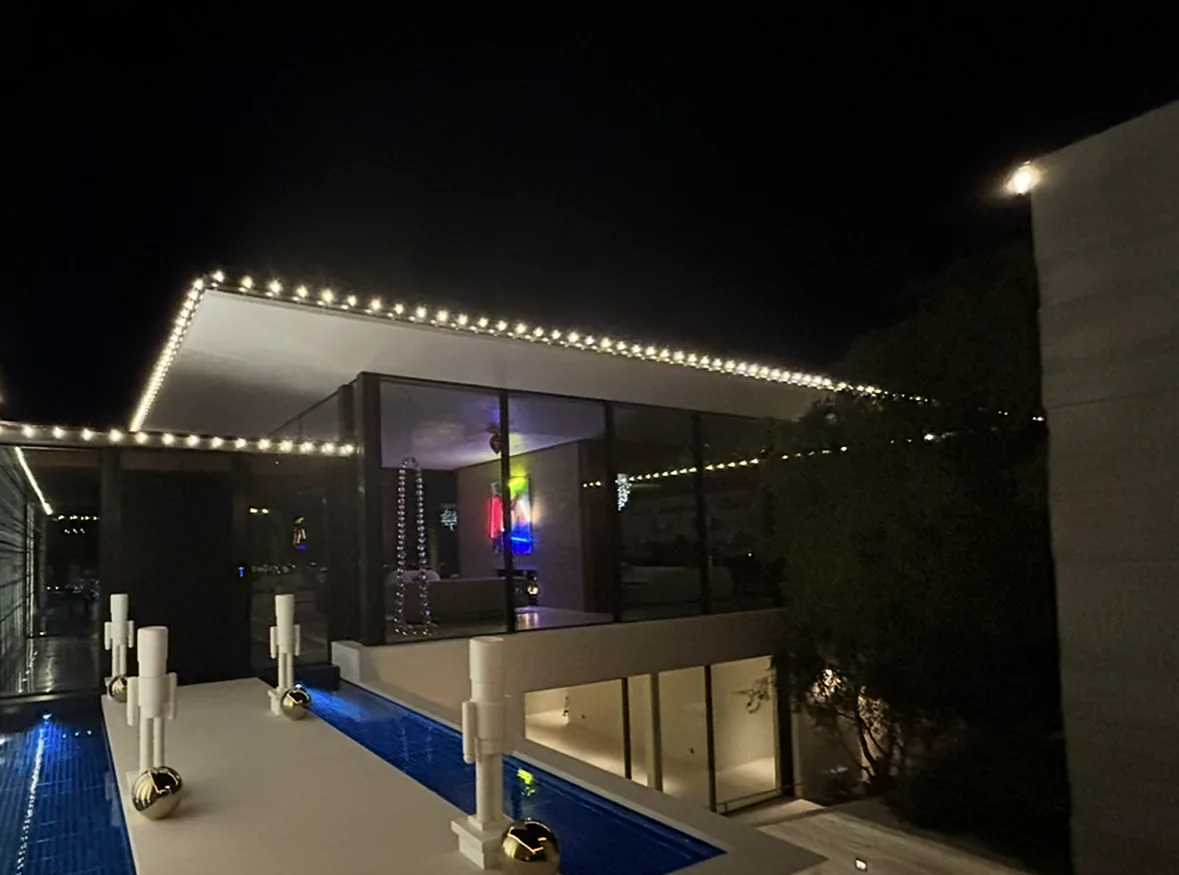
A C7's smaller profile gives a finer, tidier line. It's the right scale when people see the lights up close, or when the house itself is modest in height.
- ✓ Single-story eaves on ranch and cottage-style homes
- ✓ Walkways, porch rails and low garden fences
- ✓ Window frames, door surrounds and dormers
- ✓ Smaller homes and townhomes on narrow lots
Where C9 Bulbs Shine
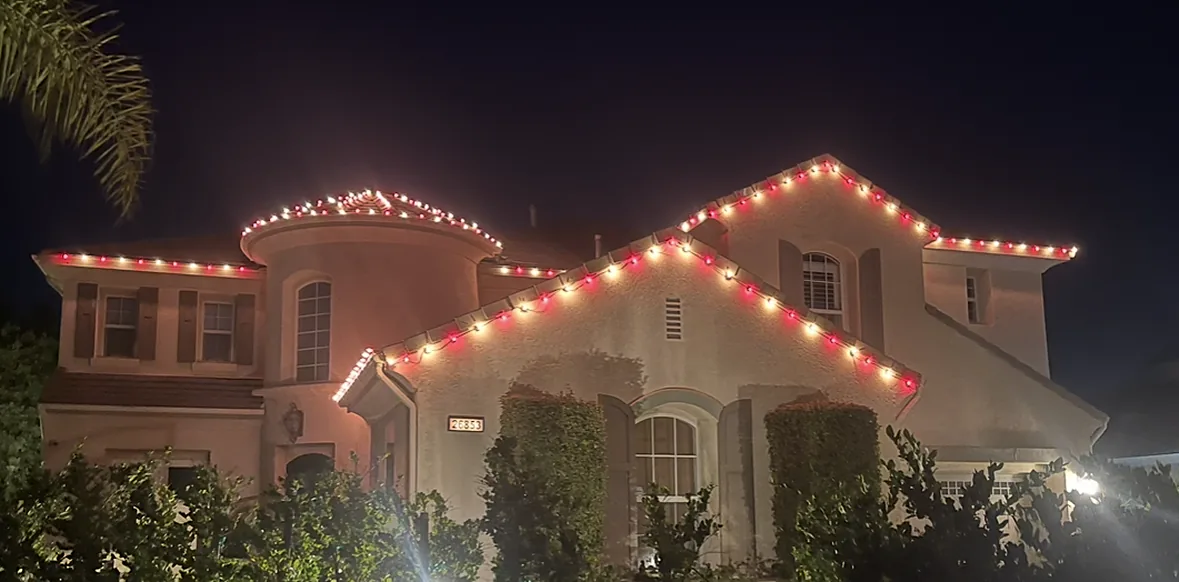
C9s give the bold, classic big-bulb look most people picture on a stately house at Christmas, and scale is why they lead on two-story rooflines. A two-story eave is often 20 feet or more off the ground, and most people see it from the street, well back from the house. At that distance a C7 line can look thin, almost like a dotted pencil line. A C9 line holds its weight and keeps its shape.
- ✓ Two-story and estate rooflines
- ✓ Tall gables, peaks and ridgelines
- ✓ Long, straight eaves viewed from the street
- ✓ Commercial buildings and grand entries
Difference Between C6 and C7 Bulbs, and Where Mini Lights Fit
The difference between C6 and C7 bulbs comes down to size and construction. A C6 is about 3/4 of an inch wide, a touch smaller than a C7, and usually comes molded onto a sealed string with fixed bulbs, often in a faceted strawberry shape. A C7 screws into an E12 socket, so each bulb can be replaced. That makes C6s handy for shrubs, wreaths and garland, while C7s belong on rooflines and trim.
C6 vs C9 isn't really a contest: they do different jobs. A C9 outlines a roof seen from the street, and a C6 adds texture to greenery seen from the front walk. Mini lights go smaller still and are the go-to for wrapping trunks and branches. Picture C9s spiraled up a live oak trunk: you'd see a string of ornaments, not a glowing tree. Our outdoor tree lighting page shows how we approach trunks, canopies and cascades.
LED vs Incandescent: Watts and Outlets
A traditional incandescent C7 draws around 5 watts per bulb and a C9 around 7 watts. Commercial LED versions typically draw less than a watt each, which matters on a big roofline with only a couple of exterior outlets.
Here's the math. A standard 15-amp outdoor circuit supplies about 1,800 watts, and good practice keeps a continuous load near 80 percent of that, about 1,440 watts. That's roughly 200 incandescent C9s. If nothing else shares that circuit, it can carry well over a thousand LED C9s on paper, so the practical limit becomes the maximum number of connected runs printed on the stringer's tag, and how many runs can reach each outlet without visible cords. Glacier plans power and cord runs from existing outdoor outlets, so that math is settled before install day.
LEDs also run cool and use plastic lenses, and commercial-grade bulbs are sealed against Houston rain.
Socket Bases: E12 vs E17
C7 bulbs use an E12 candelabra base, roughly the size of a chandelier bulb socket, and C9 bulbs use a larger E17 intermediate base. They are not interchangeable, so check the base before buying replacements.
SPT-1 vs SPT-2 Wire
Professional C7 and C9 stringers come on bulk spools of 18-gauge wire, usually labeled SPT-1 or SPT-2. At the same gauge both carry the same current; SPT-2 has a thicker jacket that stands up better to UV, rubbing against gutter edges and repeated seasons, which is why pros use it on rooflines. Slide-on zip plugs are made for one jacket size, so an SPT-1 plug won't seat properly on SPT-2 wire, and a loose plug is an outage waiting for the first rain.
Typical Spacing
Stringers come with sockets at set intervals, commonly 6, 8, 12 or 15 inches apart. A 12-inch spacing is the classic choice for C9 rooflines because it reads as a clean line of bulbs and makes counts easy: a 60-foot eave takes about 60 bulbs. C7s are often spaced at 8 or 12 inches.
Whichever you choose, keep one spacing across each roofline and each type of element. Mixing 8-inch and 12-inch runs on the same roof is one of the most common ways a display ends up looking homemade.
Clips and Bulb Orientation
All-in-one clips hold a C7 or C9 socket on a gutter lip or under a shingle edge, and ridge-cap clips straddle a ridgeline; tile and slate need their own approach, covered in our Houston cost guide. On gutters, bulbs usually stand upright so each one reads as a point of light; on rake edges they follow the slope at the same angle, so the gable looks drawn with a ruler.
Choosing a Color
Warm white, pure white or multicolor
Warm white, typically around 2700K to 3000K, is soft and candle-like. It flatters red brick, limestone, cream stucco and traditional Georgian or Tudor homes. Pure or cool white, often 5000K and up, is crisp and icy, a natural fit for modern architecture and white exteriors. Multicolor brings the nostalgic, family-first look. The one rule: never mix different whites on the same house. Even two warm whites from different brands can disagree, so buy every bulb from one product line.
Faceted vs smooth
Faceted bulbs have a cut, gem-like lens that throws sparkle and looks brighter from a distance. Smooth bulbs come transparent, bright and clean, or opaque, mimicking vintage ceramic with a softer, more even glow.
The Houston Angle: Big Houses Want Big Bulbs
Houston's grand neighborhoods practically make the case for C9s on their own. Two-story Georgians in River Oaks, steep French and Tudor roofs in Memorial, and deep lots set back behind live oaks in Tanglewood all put the roofline far from the street. C9s are the size that reads at that distance. If you live in one of those neighborhoods, start with Christmas light installation in River Oaks or residential Christmas lights in Memorial.
Smaller homes deserve the right scale too. A single-story cottage or a restored bungalow on a tight lot in the Heights, with a porch eave only nine or ten feet off the ground, can look overwhelmed by giant bulbs a few feet from the sidewalk. C7s keep the proportions right. Our Heights Christmas light installation page covers lighting older and smaller homes.
A larger home can pair C9s on the roof with C7s on windows or porch rails, in one matched warm white, so the eye reads the main lines first and the detail second. On a design consult we look at eave height and how far the house sits from the street before choosing a bulb.
Why Pros Custom-Cut Every Run
Professional installers work from spools of bulk lighting wire with sockets at a fixed spacing. Each run is cut to the exact length of that section of roof and finished with a slide-on plug, so bulbs land evenly at the corners, gables meet cleanly at the peak, and the connections tuck out of sight. That attention is the core of our Christmas light installation service.
Short Answer: Which Should You Use?
- ✓ C9: two-story homes, estates and tall rooflines
- ✓ C7: single-story eaves, walkways and smaller homes
- ✓ C7 + C9: big roofline plus finer windows and porch
- ✓ C6 or minis: trees, shrubs, wreaths and garland
- ✓ Permanent track: a year-round line under the eaves
If you'd rather skip bulbs altogether, permanent Christmas lights mount a low-profile track under the eaves that stays up all year. For a classic seasonal look designed around your home, explore our residential Christmas lights service or request a free custom quote.

Ready for a Free Quote?
Tell us about your property and we will put together a custom design and quote for your Houston home or business.
Frequently Asked Questions
+What is the difference between C7 and C9 Christmas lights?
+What are C7 and C9 bulb dimensions?
+What is the difference between C6 and C7 bulbs?
+Can I use C7 and C9 Christmas lights together?
+How far apart should C9 bulbs be on a roofline?